Inflammatory Bowel Disease
What is it?
Inflammatory bowel disease (IBD) is an autoimmune condition when your immune system attacks your own bowel causing it to be inflamed. It is not the same as irritable bowel syndrome (IBS), although both conditions may share similar symptoms such as abdominal pain and diarrhoea. IBS does not cause rectal bleeding and is not life-threatening compared to IBD.

How common is it?
IBD affects people in any ethnic group but is more common in Jewish populations and it is more common in the Northern Hemisphere. 5% to 10% of IBD patients have a first degree relative affected by the disease.
The incidence of inflammatory bowel disease is on the rise. The incidence is 12 per 100,000 in paediatric population.
What are the signs and symptoms?
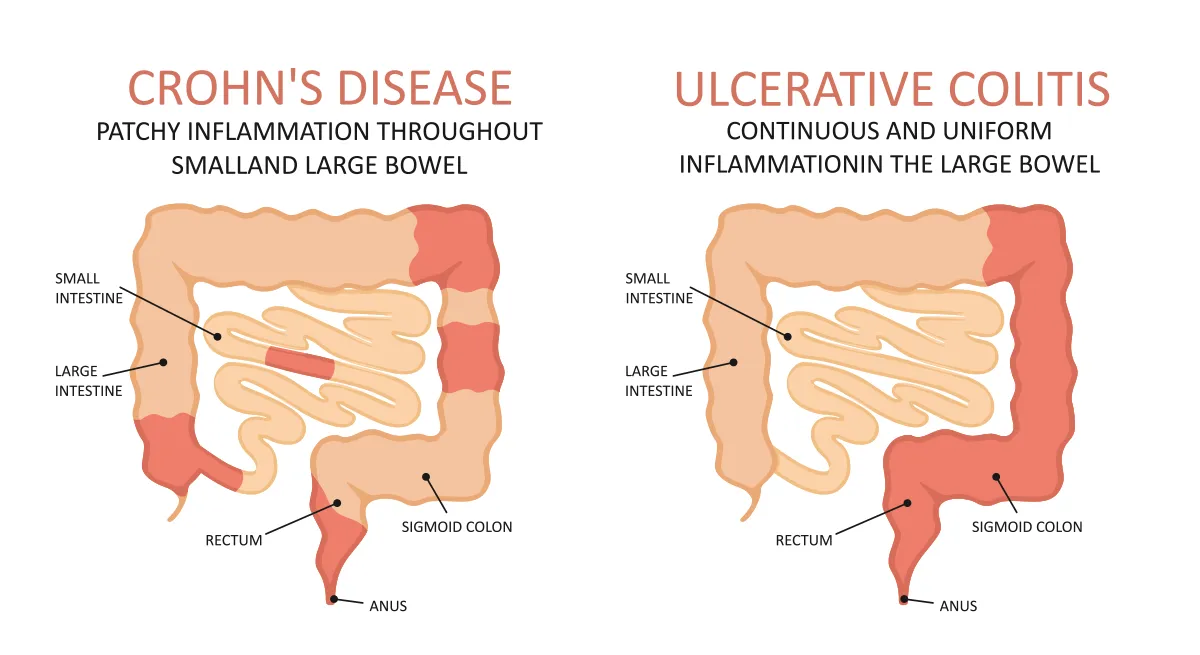
There are two main types of IBD: Crohn's disease and Ulcerative Colitis. The symptoms of both conditions can be similar such as diarrhoea, abdominal pain, rectal bleeding and weight loss. Crohn's disease affects the whole length of the digestive tract from mouth to anus, whereas ulcerative colitis only affects the large bowel. Crohn’s disease can cause growth failure. IBD suffers may experience lethargy, joint pains, dry eyes, mouth ulcers and poor appetite.
How is it diagnosed?
IBD is diagnosed by endoscopy (gastroscopy and colonoscopy). Ulcers are often seen in the large bowel. In Crohn's disease, ulcers can also be seen in the upper gastrointestinal tract.
The histology will show bowel inflammation. Crohn's disease affects the whole layer of the bowel wall, whereas ulcerative colitis only affects the inner lining of the large bowel wall whereas Crohn’s disease can affect other other layers of the intestinal wall. Granuloma can sometimes be observed in Crohn's disease but not in Ulcerative Colitis. MRI small bowel is also used to delineate the small bowel involvement in Crohn’s disease. A video capsule endoscopy to capture small bowel ulcers is sometimes needed when endoscopy and MRI small bowel do not yield positive findings in the presence of raised inflammatory markers.
What is the treatment?
The treatment for Crohn's disease is enteral nutrition such as Modulen. Patients may also need immunosuppression medications such as azathioprine and steroids. In severe cases, a biologic may be required to switch off the bowel inflammation.
The treatment of Ulcerative Colitis is non-steroidal 5-aminosalicylic acid with or without steroids and azathioprine. In severe cases, biologics are also needed. IBD is a lifelong condition but can be controlled with medications in majority of the cases.
Surgery may be indicated in severe cases. 70% of Crohn's sufferers and 30% of ulcerative colitis sufferers will require surgery at least once in their lifetime. Compliance with treatment is vital to control the disease.
Important notes:
Crohn’s and Colitis UK and CICRA (Crohn's in Childhood Research Association) provide help and support for people with inflammatory bowel disease.
Book Appointment
Call 07961 767 854 or complete our enquiry form. We try to respond within 30 minutes between 7.00am and 7.00pm (London time).